Published July 14, 2026 · by San Juan Roofing Co.
Key takeaways
- Flashing is the metal that seals your roof's joints and openings — chimneys, walls, valleys, skylights, and vents. It's where most leaks really start.
- A leak almost never starts out in the open shingles. It starts where two surfaces meet and the flashing has failed.
- A bead of caulk is a band-aid that buys months. Real re-flashing rebuilds the metal and buys years.
- Salt air near the water eats cheap galvanized flashing and fasteners fast. Marine-grade metal and stainless fasteners are worth it out here.
- Most island flashing repairs run $450–$3,500, depending on the detail. A free on-island inspection gives you your real number.
Your roof can look perfect from the driveway and still leak. In the San Juan Islands, the cause is almost always flashing — the metal that seals the seams and openings most homeowners never think about. Here’s what flashing is, how to spot it failing, why a bead of caulk won’t save it, and what a real flashing repair costs out here.
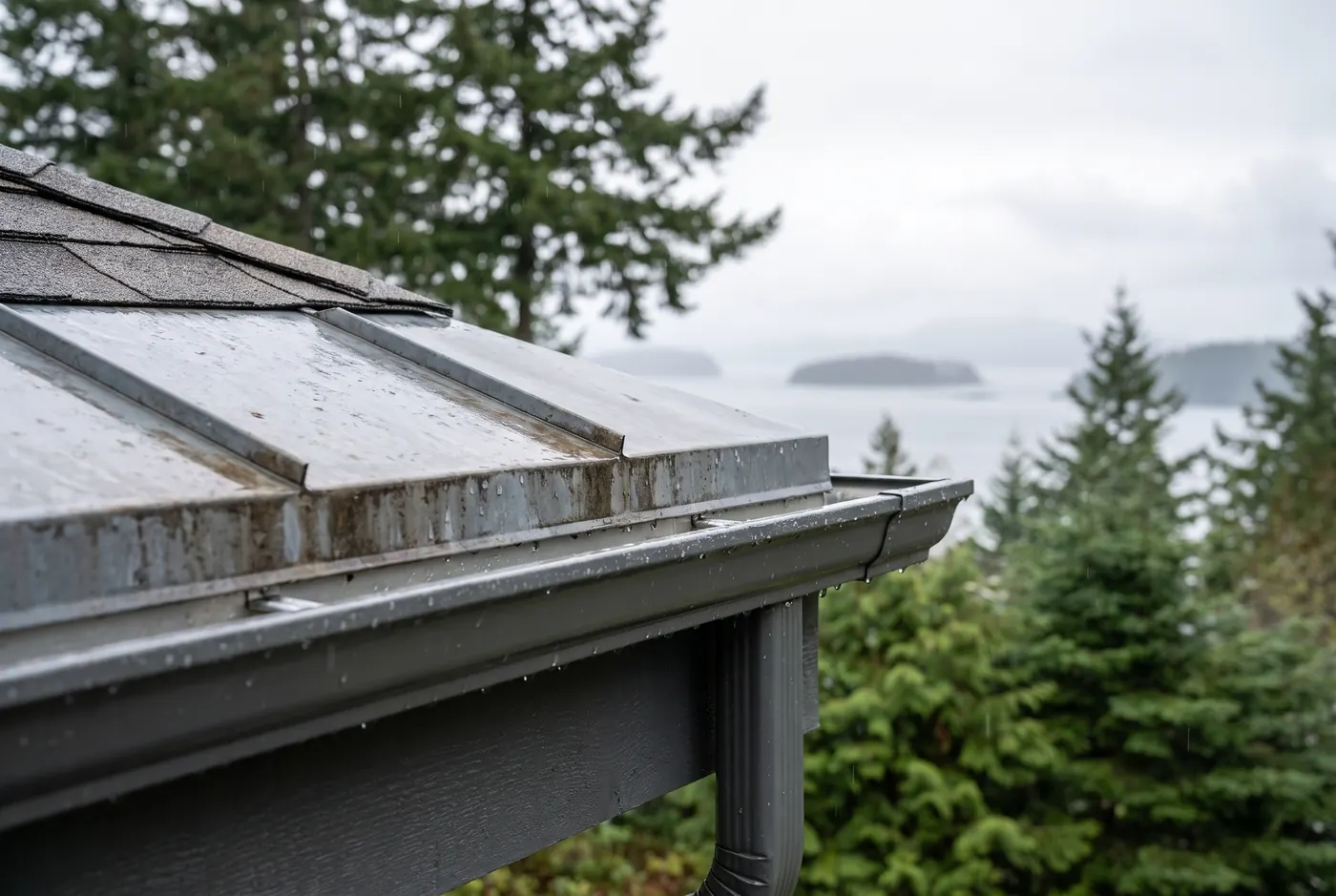
Roof flashing is the metal that seals the joints and openings on your roof — chimneys, walls, valleys, skylights, and vents. It’s where most leaks start, not out in the open shingles. Flashing repair fixes or replaces that metal so water runs off cleanly instead of getting into your walls and ceilings.
Why is flashing the number-one source of island leaks?
A roof sheds water well across its open middle. Shingles, metal panels, and cedar shakes are all built to move rain downhill fast, and out there they rarely fail early. The trouble starts at the edges — every place the roof changes direction or something pokes through it.
Those spots can’t rely on the roofing alone, so we bridge them with flashing: bent, overlapped metal that steers water back onto the roof and out to the gutters. When that metal loosens, rusts, or was put on poorly, water takes the easy path straight inside. That’s why you can have a ten-year-old roof with perfect shingles and a stain spreading across the bedroom ceiling. The shingles are fine. The flashing failed.
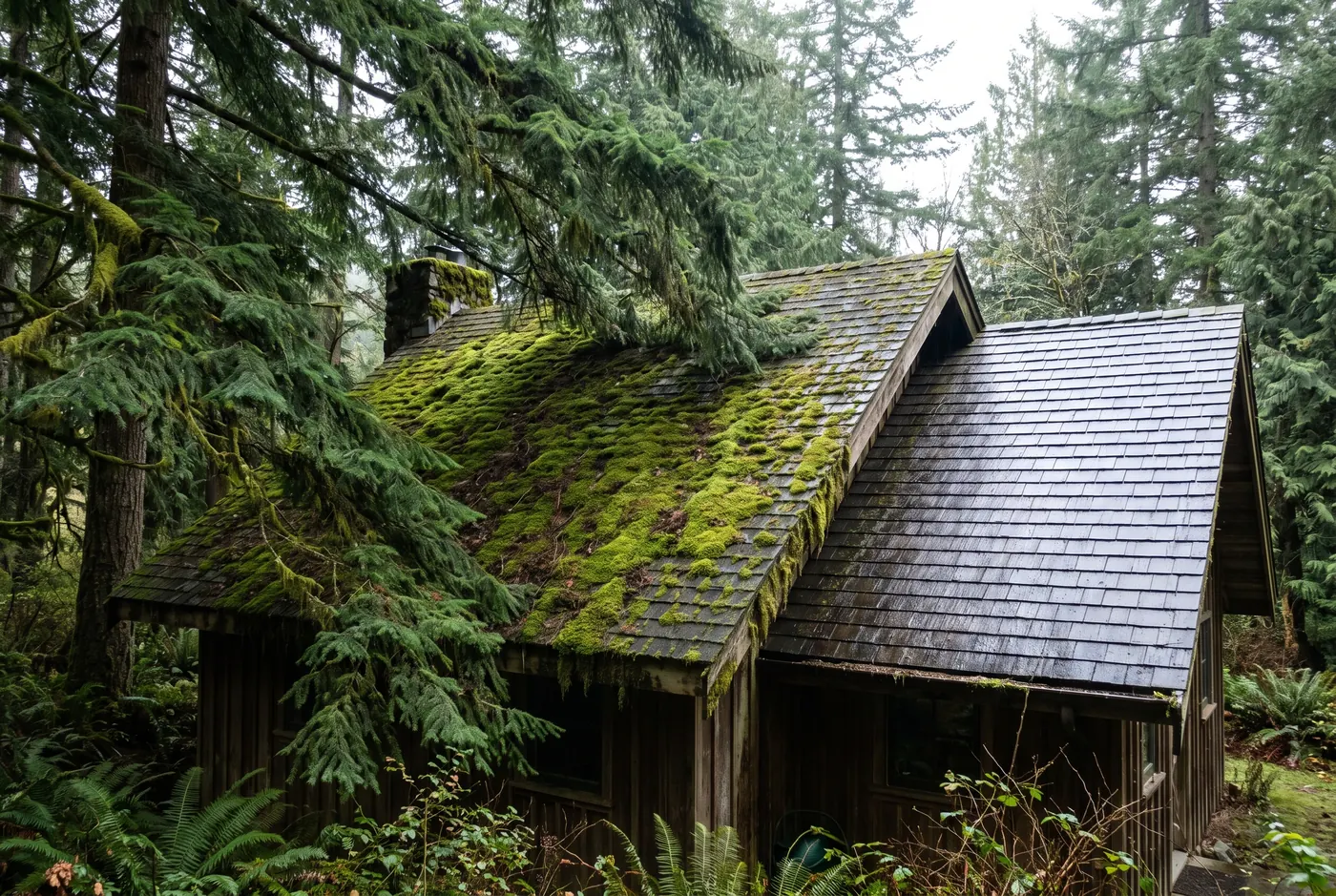
Our weather makes it worse. The islands get about 40 inches of rain a year, heaviest in November, and west-side wind runs about 20% stronger than Anacortes. Wind lifts and tires out flashing. Steady rain finds every gap. And moss creeping down shaded north slopes under the Douglas firs traps water against the metal. If you’re chasing a leak, our roof leak repair guide walks you through it — but nine times out of ten, the trail ends at the flashing.
What are the types of roof flashing, and how do they fail?
Different spots need different flashing. Knowing which is which helps you describe the problem — and understand what a real repair takes. Here are the ones on almost every island roof:
| Flashing type | What it protects | Common failure sign |
|---|---|---|
| Step flashing | Where a roof meets a sidewall or dormer | Water stains on inside walls just below where roof meets wall |
| Counter flashing | Caps step flashing at masonry — chimneys, brick walls | Loose or pulled-out metal; crumbling mortar reglet above it |
| Kick-out flashing | Sends water off the roof-wall edge into the gutter | Rot, dark staining, or peeling paint at the base of the wall |
| Valley flashing | The channel where two roof planes meet and carry heavy water | Rust streaks, debris dams, or leaks running along the valley line |
| Chimney flashing | The base and sides where the chimney passes through the roof | Dark stains around the chimney and drips in the attic beside it |
| Skylight flashing | The curb around a skylight | Drips or condensation around the skylight frame in hard rain |
| Vent boot (pipe boot) | Plumbing vents and pipe penetrations | Cracked rubber collar and ceiling stains directly below the vent |
Valleys and chimneys cause the most trouble because they gather water. A valley funnels runoff from two roof planes at once, and a chimney needs four flashing pieces working together. Builders skip kick-out flashing the most, and leaving it out quietly rots wall sheathing for years.
Why is sealant a band-aid instead of a real flashing repair?
When people find a flashing leak, the first move — and the cheap contractor’s move — is to smear roofing cement or caulk over it. It stops the drip for a while, so it feels like a fix. It isn’t.
Flashing works because of how it’s shaped, not glue. Done right, each piece overlaps the one below it, so gravity carries water down and out — the same way shingles do. A bead of caulk does none of that. It just plugs a gap, and caulk is the first thing our weather kills. Through 40 inches of rain a year, sun, and freeze-thaw cycles, caulk dries out, shrinks, and cracks, usually within a season or two. Then the leak comes back — and now there’s often hidden rot behind it, because water was seeping in the whole time.
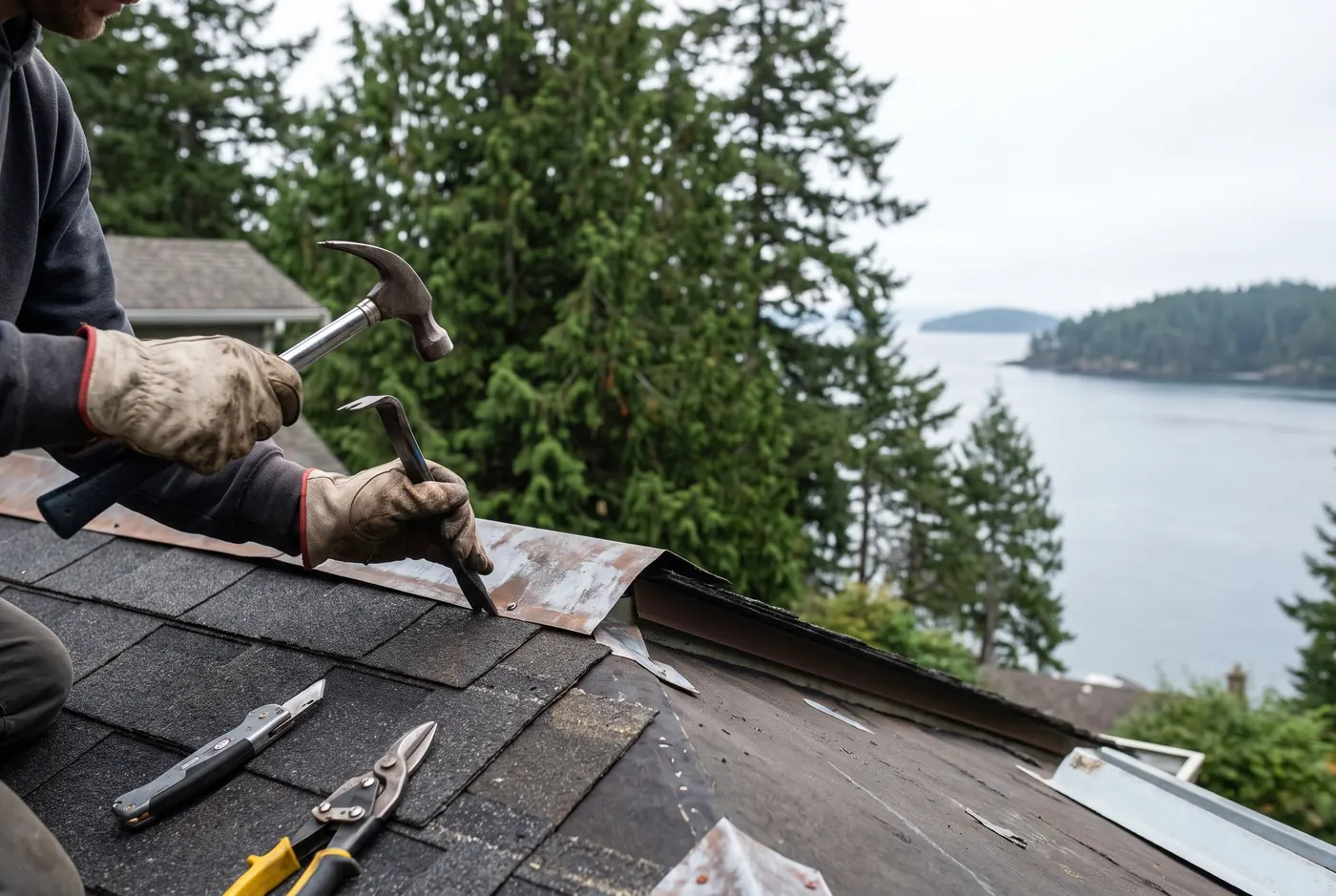
Real re-flashing rebuilds the spot. We lift the roofing, put in the right-sized, overlapped metal, tie it into ice-and-water membrane where it belongs, and let the metal do the work — not the glue. Caulk has a job as a backup on flashing that’s already done right. As the main defense, it’s a band-aid on a wound that needs stitches. Honest roof repair means fixing the flashing right, not hiding it under a tube of caulk.
What does salt air do to cheap flashing?
Near the water — and on these islands, that’s a lot of homes — the enemy isn’t just rain. It’s salt. Salt air is corrosive, and it eats cheap flashing metal and fasteners fast. Bargain galvanized flashing and standard nails can start rusting within a few years near the shore. Once the metal thins and gets holes, it stops shedding water no matter how good it looked on day one.
That’s why marine-grade materials aren’t an upsell out here — they’re the baseline. Near saltwater we use 24-gauge metal with Kynar 500 / PVDF coatings and stainless, rust-resistant fasteners, so the flashing outlasts the roof instead of failing first. It’s the same reason metal is the best long-term island roof. It’s the difference between flashing that survives the salt air and flashing you’ll be fixing again in five years. If your gutters and flashing were done on the cheap, our gutters and flashing work rebuilds them to island-grade spec.
How much does roof flashing repair cost?
Flashing repair is one of the cheaper roofing fixes — and one of the smartest, because catching it early saves thousands in interior rot. Most island flashing repairs fall inside our standard repair range of $450–$3,500, depending on the detail and how much roofing has to come up to do it right.
| Flashing repair | Typical island range |
|---|---|
| Single vent boot / pipe boot replacement | $150–$500 |
| Localized step or counter flashing repair | $450–$1,500 |
| Chimney re-flashing | $500–$2,000+ |
| Skylight re-flash or re-seal | $400–$2,500+ |
| Valley re-flashing | $800–$3,000+ |
A few honest notes on island pricing. Ferry costs add up that mainland jobs don’t have — staging crew and materials, plus hauling old roofing off-island. And marine-grade metal costs more than the bargain stuff for good reason. These ranges are for learning only; every figure here is an estimate, not a quote. A free on-island inspection is the only way to get your real number, and we’ll always give you honest repair-or-replace advice instead of talking you into a full roof you don’t need.
Can flashing be repaired, or does it need replacing?
Sometimes flashing just needs to be re-secured and re-sealed. If the metal is sound and only lifted or lost its caulk, a repair does the job. But if the metal is rusted through, too small, badly bent, or was “installed” with a caulk gun instead of real overlaps, it has to be replaced. Re-flashing it right is the only repair that lasts, and pouring money into failing metal just puts off the inevitable.
The honest answer for your roof comes from getting eyes on it. Our roof inspections and maintenance service includes a free on-island look at every flashing point — step, counter, kick-out, valley, chimney, skylight, and vent boots — with a written summary of what’s fine, what needs work now, and what can wait. Add yearly moss treatment on shaded slopes, and small flashing issues never become ceiling stains.
Stop the leak at its real source
If you’ve got a stain spreading, a drip near the chimney, or flashing that’s clearly seen better winters, don’t wait for the next November downpour to make it worse. Flashing repair is one of the cheapest fixes on a roof — right up until it turns into rotted sheathing and a full replacement.
Call San Juan Roofing Co. at (360) 205-1462 or reach out through our contact page, and we’ll come out anywhere in the islands — Friday Harbor to Eastsound to Lopez Village and the outer islands. We’re a licensed, bonded, and insured island roofing contractor. Our inspections are free, and every repair is backed by our workmanship warranty.
Frequently asked questions
Can flashing be repaired, or does it need replacing?
How much does flashing repair cost in the San Juan Islands?
Why does my roof leak around the chimney but the shingles look fine?
Is roofing sealant enough to fix a flashing leak?
How often should island flashing be checked?
Ready to move forward?
Talk to an island-based roofer — free inspection, honest advice.