Published July 14, 2026 · by San Juan Roofing Co.
Key takeaways
- Check the Washington license, bond, and insurance yourself with the state L&I 'Verify a Contractor' tool. Get every promise in writing before work starts.
- Favor island crews who price ferry travel, material staging, and off-island disposal honestly, instead of hiding those costs or springing them on you later.
- Watch out for mainland lowball quotes and out-of-area storm-chasers who show up after a windstorm and vanish before the next November rain.
- A real written estimate spells out the scope, materials, marine-grade coatings and fasteners, ferry costs, warranty, and cleanup — not just one bottom-line number.
- The honest island choice knows salt air, west-side wind, and north-slope moss firsthand, and stands behind the work with a workmanship warranty.
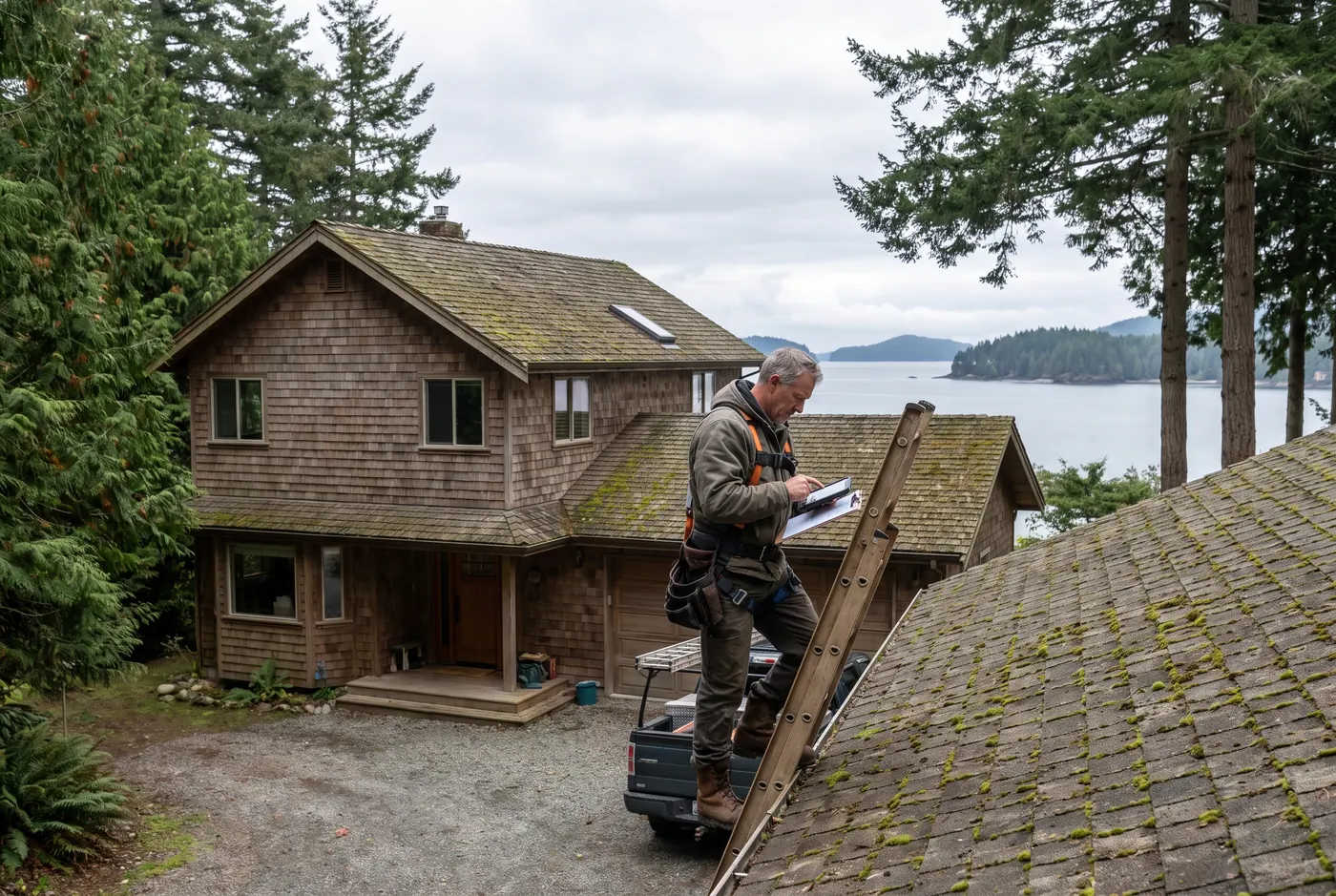
On the islands, hiring the wrong roofer costs you more than a bad haircut costs on the mainland. The crew you choose matters more than the shingle you pick. Out here the wrong choice can mean a mainland company that ghosts you across the ferry. Or a storm-chaser who’s long gone before the next November downpour finds the leak. Here’s how to choose a roofing contractor you can count on in the San Juan Islands.
To choose a roofing contractor in the San Juan Islands, check their Washington state license, bond, and insurance, and get every promise in writing. Favor island crews who price ferry travel, staging, and off-island disposal honestly. And watch out for mainland lowball quotes and out-of-area storm-chasers who vanish after the check clears.
How do you verify a roofing contractor’s Washington license?
Start here, before you talk price. Every real roofing contractor in Washington is registered with the state Department of Labor & Industries (L&I), which tracks their license, surety bond, and liability insurance. Ask any roofer for their registered business name and license number. Then look them up yourself in the L&I “Verify a Contractor” tool. Check three things: the license is active, the bond is in place, and insurance is current.
Don’t accept “we’re fully licensed and insured” as a spoken answer. Get it in writing on the estimate, and check it yourself. A contractor who is proud of their standing hands you the number and tells you to check it. One who stalls, gives you a name that won’t check out, or changes the subject is telling you all you need to know. San Juan Roofing Co. is a licensed, bonded, and insured Washington roofing contractor — and we want you to confirm it, just as you should with anyone who climbs on your roof. You can read more about who we are and how we work before you call.
What questions should you ask a roofing contractor?
The right questions separate a real island contractor from a tourist with a ladder. Use this checklist when you interview any roofer. Pay as much attention to how they answer as to what they say.
| Question to ask | Good answer | Red flag |
|---|---|---|
| Are you licensed, bonded, and insured in Washington? | ”Yes — here’s our L&I number, verify it yourself.” | Vague reply, “working on it,” or won’t give a number |
| Does your estimate include ferry travel, staging, and off-island disposal? | Itemized in writing and explained plainly | Oddly cheap, no mention — costs appear later |
| Are you based on or regularly working the islands? | Yes, names recent Friday Harbor, Eastsound, or Lopez jobs | ”We come over from the mainland after storms” |
| Can I get a written estimate and workmanship warranty? | Detailed written estimate plus warranty terms | Verbal-only price, wants a deposit to “hold the crew” |
| What roofing works best in salt air, and why? | Marine-grade Kynar 500 / PVDF on 24-gauge metal, corrosion-resistant fasteners | Generic answer, pushes the cheapest option |
| How will you handle north-slope moss? | Zinc or copper ridge strips, gentle treatment, never pressure-wash shingles | ”We’ll just pressure-wash it clean” |
| Can you give local island references? | Named island clients and addresses | Only mainland references, or none at all |
| How is payment structured? | Reasonable schedule tied to progress | Large cash deposit up front, or “cash only” |
If a contractor clears that table without flinching, you’re talking to a pro. If they trip on ferry logistics, salt-air materials, or the license question, keep looking.
Why hire an island-based roofer?
Because place changes the whole job. The San Juan Islands get about 40 inches of rain a year, heaviest in November, with west-side wind about 20% stronger than Anacortes and steady moss on shaded north slopes under the Douglas firs. A roofer who lives with those conditions builds for them. One who visits does not.
The costliest hiring mistakes out here share a theme — mainland crews who forget the islands are islands:
- Ferry and lodging costs get “found” mid-job. A mainland outfit quotes a mainland number. Then they realize the crew and every pallet of material rides the ferry, and someone has to sleep overnight. Guess who pays.
- Off-island disposal gets skipped or billed later. Tear-off waste can’t just go to the nearest transfer station. It has to be hauled off-island. Honest island estimates price that in from the start.
- Salt-air materials get swapped out to cut cost. Near saltwater you need marine-grade Kynar 500 / PVDF coatings on 24-gauge metal with corrosion-resistant fasteners. A crew chasing the lowest bid quietly swaps in cheaper metal that streaks and rusts within a few salty winters.
- The warranty walks onto the 4:30 ferry. When a mainland company’s work leaks next winter, you’re chasing a phone number across the water. An island contractor is down the road.
Out-of-area storm-chasers are the other trap. After a big windstorm, door-knockers roll off the ferry, push homeowners to sign on the spot, sometimes demand a large cash deposit, then disappear before the work is right. If your roof took a hit, slow down, document it, and read our guide on roof storm damage and insurance claims before anyone starts tarping. Real emergency help is a phone call to a local — see our storm and emergency roof repair — not a stranger on your porch.
What should a written roofing estimate include?
A single bottom-line number is not an estimate — it’s a sales tactic. A real written estimate lets you compare bids side by side and protects you if the job goes sideways. Insist on all of it:
- Company name and credentials — legal business name, Washington L&I license, bond, and insurance details, and a phone number.
- Scope of work — tear-off vs. overlay, decking repair, underlayment (including ice-and-water membrane at valleys and eaves), flashing, and venting.
- Specific materials — brand, metal gauge (24-gauge for coastal metal), coating (Kynar 500 / PVDF), fastener type, and color, so nothing gets swapped for cheaper stock.
- Ferry and logistics line — crew travel, material staging, and off-island disposal, priced out in the open, not hidden.
- Timeline and payment schedule — start window, how long it’ll take, and payments tied to progress, not a big cash grab up front.
- Warranties — both the workmanship warranty and the maker’s material warranty, in writing.
- Cleanup — debris haul-off and a magnet sweep for stray nails around the property.
Remember, even the best written estimate is just that: an estimate, not a quote, until a contractor has actually looked at your roof. That’s why a free on-island roof inspection matters — it turns a guess into your real number. If you’re buying or selling, our guide on roof inspection cost and what to expect covers the documented report side of that.
Choose the honest island roofer
You don’t have to gamble on a roof out here. Check the license, ask the hard questions, demand a real written estimate, and favor a crew that treats ferry logistics and salt air as everyday facts, not surprises. That’s the standard we hold ourselves to — honest repair-versus-replace advice, clear island-adjusted pricing, and a workmanship warranty we’re still here to honor.
When you’re ready to compare bids the right way, browse our full range of roofing services, then call San Juan Roofing Co. at (360) 205-1462 or reach out through our contact page. We’ll come to your island, look at your actual roof, and put an honest number in writing — the inspection and estimate are free.
Frequently asked questions
How do I verify a roofer is licensed in Washington?
Why hire an island-based roofer?
What should a written roofing estimate include?
How do I spot a storm-chaser or lowball quote?
Do you charge for a roofing estimate?
Ready to move forward?
Talk to an island-based roofer — free inspection, honest advice.